The Belonaire Ecosystem

Who needs to be a billionaire when you can become a Belonaire?

A Belonaire is someone who has systematically removed luck from the things that matter most for their survival, and who can then afford anything they want, just one thing at a time.

Both halves of that sentence have to be true, or the word means nothing. Someone who can afford nice things one at a time, with nothing underneath them, is still depending on luck. Here is where the idea came from, and everything built on it.

Start with the books Where this came from

What is always true

Underneath every money decision, there are two facts.

One. Wanting never ends.

There is always something just out of reach, for a person with nothing and for the richest person alive. Getting one thing reliably produces a bigger want behind it. There is nothing wrong with you for this, and nothing to cure. Deciding to want less does not work either, because a want you refuse to look at does not disappear. It comes back later, and by then you have made no plan for it.
Two. Everything you have built can be lost in a single afternoon.

A currency collapses. A diagnosis arrives. A business loses one large bet. No number of careful years protects you from a single shock that is big enough, unless you built something beforehand for the specific purpose of surviving one.

So the question was never how to want less, which does not work, and never how to avoid every shock, which nobody can do. The question is this: what has to be true underneath you before wanting more is safe?

The two kinds of questions

Answering that showed me a line running through everything.

Some of the questions you face already have exact answers, sitting inside facts you hold and have never put side by side. What a month of your life costs. Whether you could survive a year without income. The date you can afford the thing you want next. Those are not matters of opinion. They are arithmetic, and guessing at them costs you money.

The others cannot be settled by any calculation, because the things you are weighing have no measure in common. Your parent’s last years, or your children’s first. Work, or love. How much is enough. No amount of further research decides those. They need your judgment.

From the inside, the two feel exactly the same. That is why so many of us spend weeks agonizing over questions a calculator could have closed in a minute, and then guess at the ones that deserved those weeks.

And the line moves.

A great deal of what feels like judgment is simply a question nobody has built a method for yet. So rather than sorting your questions into two piles, we give each one a status and a next step.

  1. Answered.

    The arithmetic is done. You see the figure and the facts it was worked out from.

  2. One fact away.

    Something is missing that only you can supply. You see what it is, how many other answers supplying it would unlock, and a link to the exact field where it goes.

  3. Evidence would settle it.

    This one is not a matter of opinion. It is a fact nobody has looked up yet, so we go and look it up.

  4. Somebody has a method.

    Other people have thought hard about this question. You see how they did it, and you build your own approach from theirs.

  5. Nobody has a method.

    Then you build one: a test, a rule for sorting, a quantity you can count. Once you have built it, it is yours to keep and yours to share.

  6. Yours alone.

    No calculation can reach this one, and none should. It is put in front of you clearly, with everything it rests on, and then it is left to you.

Two things move the line. Every fact you supply moves a question up from the bottom. Every method somebody builds moves one down from the top.

What is left after both have done their work is genuinely yours, and that is the part worth your judgment.

A life where the only questions still sitting on your desk are the ones that were actually yours to answer.

Where it starts

Three books, one for each kind of question.

Everything in them works with a pen, a notebook and a basic calculator. No software required.

Book One

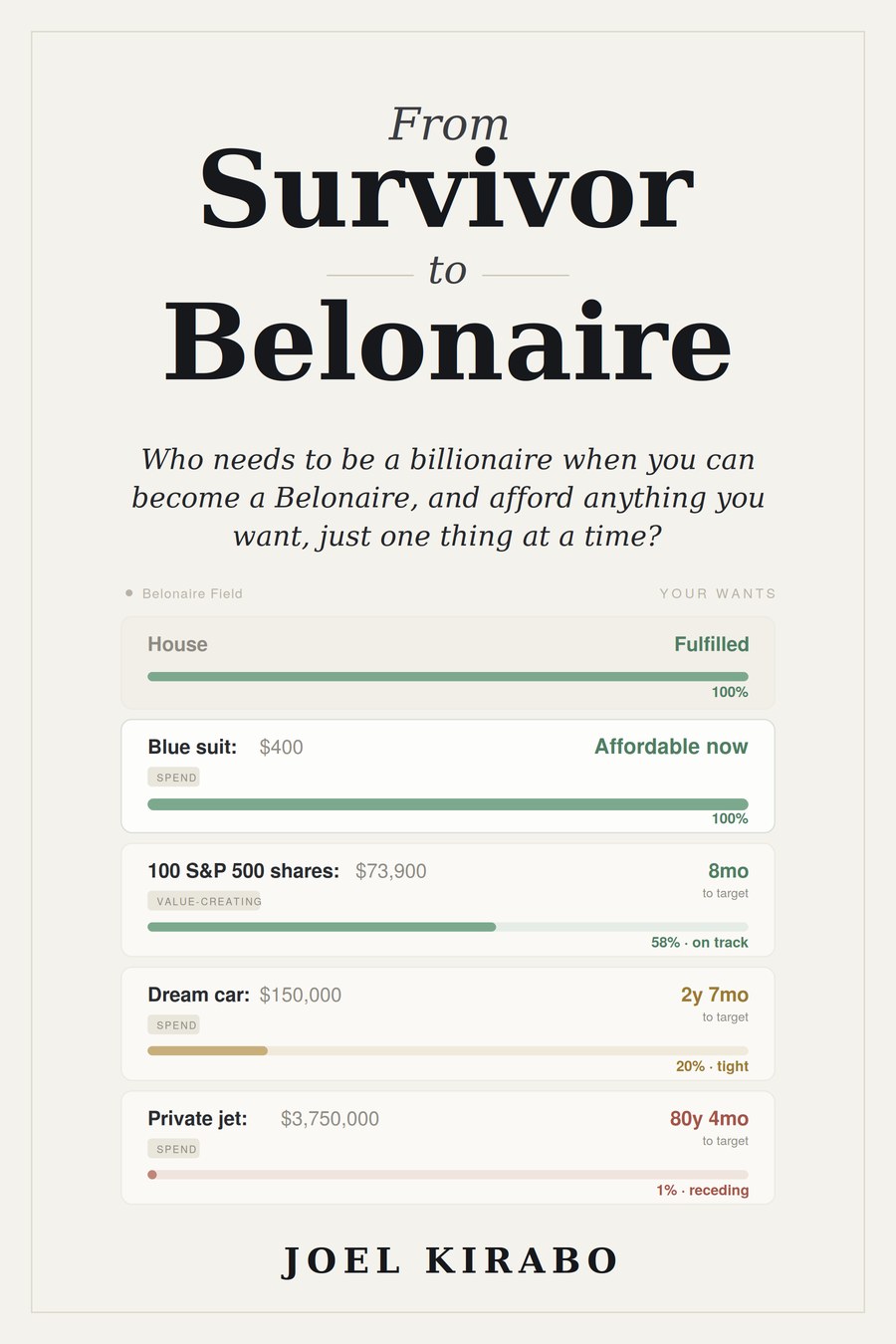
From Survivor to Belonaire

Questions about the world.

What your life costs, who depends on you, what you actually have, and the date you can afford what you want next. Answerable today, from facts you already hold.

Book Two

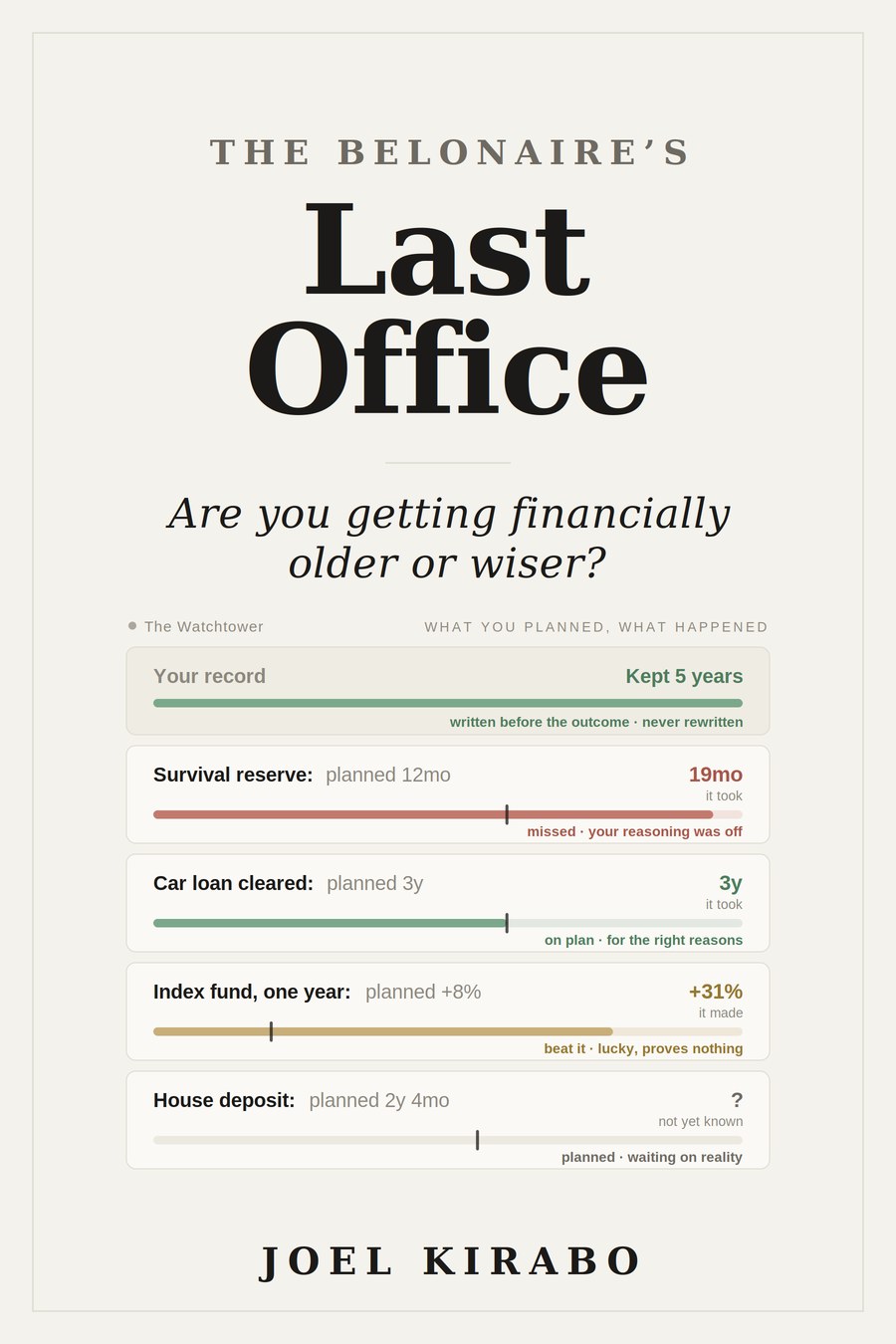
The Belonaire’s Last Office

Questions about yourself.

Whether a result was earned or lucky, and whether the years are making you wiser. Answerable too, but only over time, against a record you kept before you knew how things would turn out.

Book Three

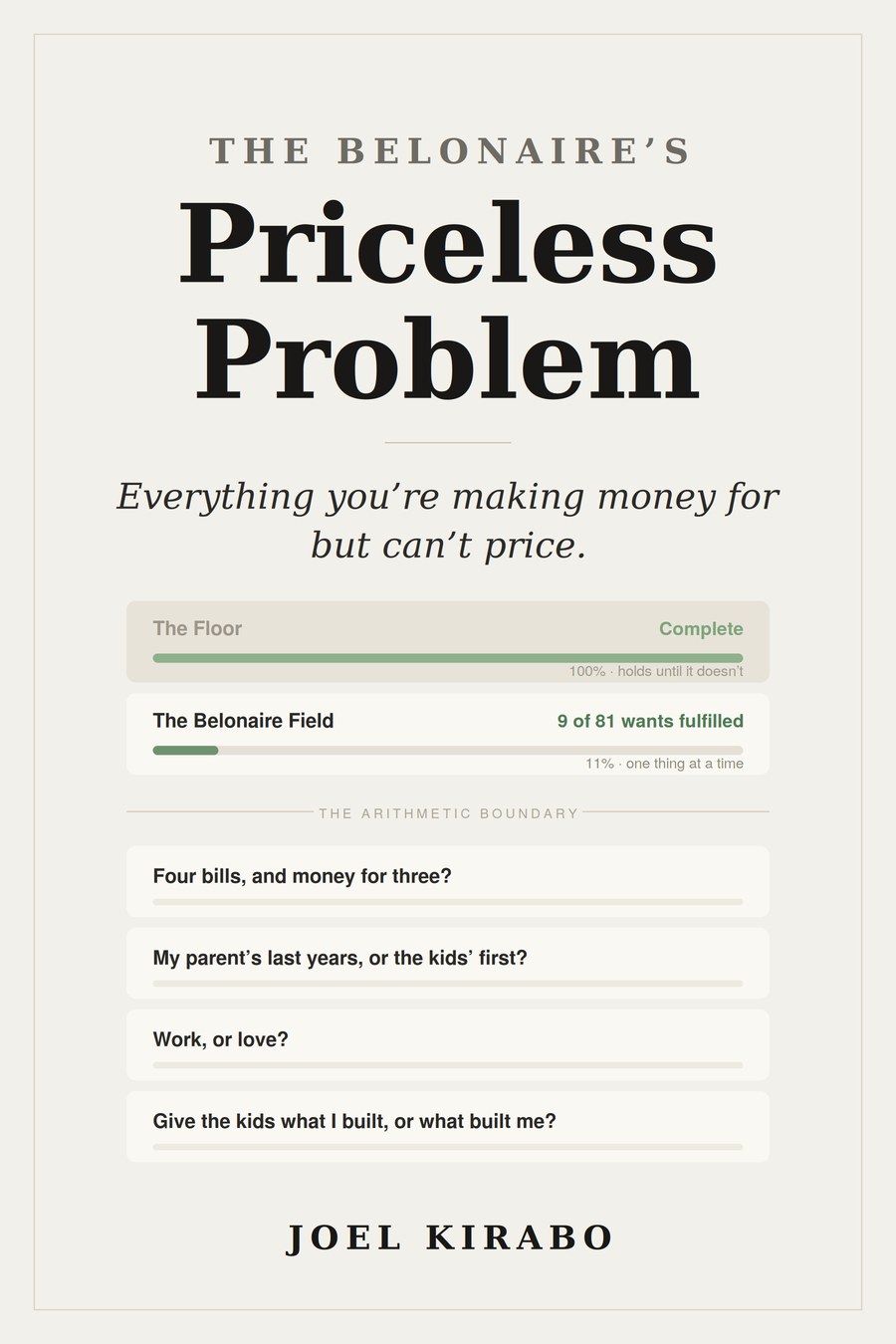
The Belonaire’s Priceless Problem

Questions no calculation can settle.

What your survival was actually for, and what to do when arithmetic has done everything it can and the choice is still yours.

Sourced
every statistic, finding and quotation, credited to where it came from
Checkable
every sum in every story, so you can run it yourself
Honest
about what the books still can’t solve
Yours
every answer to a question only you can decide

The books check what they claim, and say plainly where the arithmetic ends.

Feel it first

Watch both facts happen to a household in one afternoon.

A board game about how households survive. The board is a calendar. Whoever goes the furthest wins. You build a household and play out its years, and you watch what wanting and bad luck do to it. By the end you will have found the line yourself: the decisions you could have calculated, and the ones you had to make.

Three ways to play

$3.99 a month

Play with friends on screen

Invite people into your game and play together from wherever each of you is.

$65, pre-order

The physical board game

Everything you need is in the box: the board, the money, the cards. Play it the way you would play any board game, with nobody’s screen involved.

Compute what can be computed

The arithmetic is not yours to do by hand.

An answer that can be reached by calculation should be reached that way, every time, from your own figures rather than from a rule of thumb.

Belon works out everything that follows from what you record, and shows you each result together with the facts behind it, so you can check it rather than take it on trust. When something is missing, Belon names it, tells you what supplying it would unlock, and links you to the field where it goes. When the arithmetic reaches its limit, Belon says so, tells you which of the six statuses that question is in, and tells you what would move it.

For your household

Belon

Everything you can compute about your money.

$12 a month

For your business

Belon Enterprise

Everything you can compute about your business’s money.

$49 a month

Nothing is hidden and nothing is held back for a higher tier. Every question is there for you to read, including the ones still waiting on something.

The part a calculator cannot close

Hand the rest to an AI that knows which job it is doing.

Statuses two through five are real work, and an AI is good at that kind of work. So you can hand any of them over. Download a packet, or connect your account directly to Claude or another model you already use.

What gets sent is your own position in plain language, the question itself, the facts it rests on, what is still missing, and the instruction for that kind of question. A question waiting on evidence instructs the model to go and search for it. A question waiting on a method instructs it to find how other people have approached this, and to help you build your own. A question that is yours alone instructs it to lay the question out for you and stop there.

  1. No model output can change a figure Belon calculated. Ever. If an answer comes back disagreeing with the engine, the engine’s figure stands and the answer is rejected.
  2. Nothing comes back unchecked. Every number in a model’s answer is compared against the number we hold, and any figure the engine never produced is refused.
  3. Nothing is recorded without a date to look at it again. When that date arrives, you are told.

It never answers the questions that are yours to answer. That is the point of it.

The eternal conversation

The other kind of question needs people, not a calculator.

I don’t have life figured out, and I don’t think anyone works it out alone. So I’m hoping we can start a conversation that doesn’t have to end, and keep it going until we figure out life together.

BelonX is where that happens. People show how they would decide something, what the decision would cost them, and what would change their mind. Bring the questions no calculation can settle. Bring a better way of reaching the ones that can.

There is one copy of every method shared here, so when somebody improves a method, it improves for everyone who uses it.

Join BelonX

More of the conversation

Blog

My notes from the eternal conversation. Money, and everything money sits inside.

Podcast

Long conversations about the choices that shape a life.

Where to start

Four ways in.

The author

Joel Kirabo is the author of the Belonaire books and the founder of the Belonaire Ecosystem, a group of projects built on one idea: removing luck from the things a household’s survival depends on. He is self-taught and is not a financial adviser. He lives in Kampala, Uganda, where his family settled after leaving Rwanda.

More about Joel

Everything, in one place

Shop

Subscribe. Take it home. All in one place.

Shop everything

Letters from the work

Notes from the eternal conversation and news of anything new. Sent when there’s something worth reading, not on a schedule.